How I bought a £10m food wholesale business
Cafe Deli supplies over 2,000 independent customers, and buying it took me a year's work. I paid for it in full on day one, which isn't how I usually do deals. Here's why I bought it, how I found it, how I structured it, and how you could fund one like it.
Watch: inside the food wholesale business I just bought
What I really bought
Three and a half years ago I bought Rossi, an ice cream company. It had a couple of vans and was listed with a few wholesalers. Getting listed with more was like pushing water up a hill.
I knew that if I bought a food services business already operating at scale, I'd be able to distribute my products at the stroke of a pen. That's what happened. What I really bought was the transport.
And it gets better. We also own a hotel, two visitor attractions, a big chain of indoor play centres and day nurseries. They all need drinks, packs of crisps and food to cook. That's what Cafe Deli does.
I'd started doing it myself, and generated about a million pounds of wholesale sales to my own businesses from the back of Rossi. It put the business under a bit of pressure. We didn't have the money, the infrastructure, the team, the knowledge or the volume to play the game at this level. Now we do.
Three reasons I bought it
Synergies are the number one reason I buy anything. Cafe Deli gave me two more on top.
Synergies
Its lorries are lined up like little soldiers. They take my ice cream and bakery products into London every day, and all around the M25.
Immediate cash flow
Work moved between my businesses and theirs the day I signed, in both directions.
A great deal
A £10m business making a million pounds of profit, with loads of capacity to do more. I think I paid a fair price for it.
Synergies are just another word for leverage. If you can find them in a business you're buying, that's more important than anything else. You've still got to make sure it's making a profit first.
Do the work once and get paid forever.
Cafe Deli was a commercially profitable business working without the owners in it. To me, that's a flipping fantastic business. My formula is E + M = S: entrepreneurship plus management equals success. I'm the entrepreneur looking for the synergies, and it already had an amazing management team running it day to day.
The orders that moved on day one
Here's what immediate cash flow means. I'd pushed about a million pounds of food services work into Rossi. Now I can hand all of that to Cafe Deli.
Going the other way, Cafe Deli was buying half a million pounds of cakes and doughnuts, and no ice cream yet. All of that can go to Rossi.
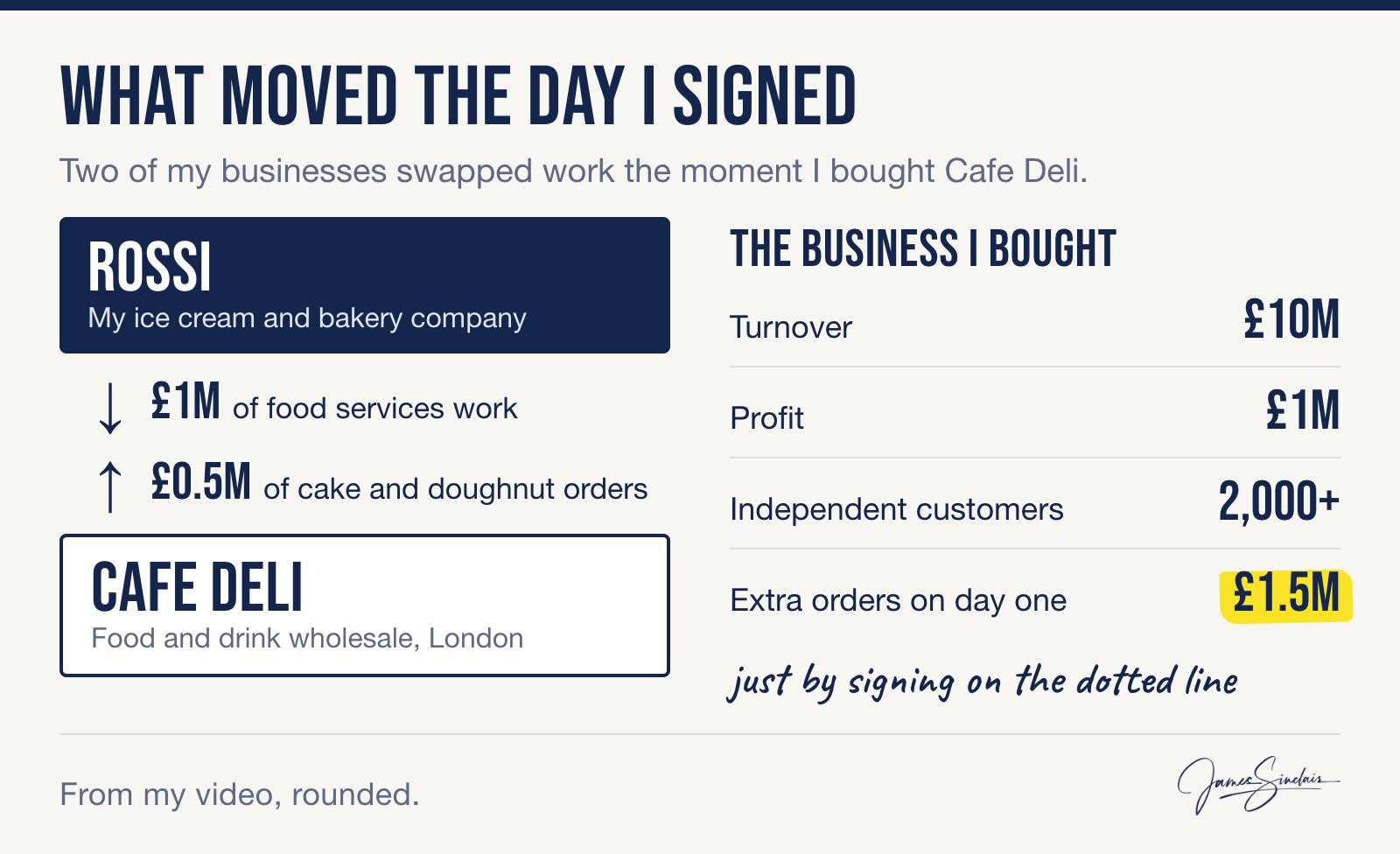
Rossi gets half a million pounds of bakery orders. Cafe Deli gets a million pounds of extra business. All just by signing on the dotted line.
The little things that add up
If you're running a business and thinking "if I just had 10% more revenue, I could afford a manager, an accountant, or that next van", you'll know why volume matters.
Now we can buy four more vans and lorries with confidence, because they're actually needed. We can go to suppliers and say we'll take 10 pallets, and suppliers want to help you out more.
With this many vehicles, I'll employ a mechanic straight away, so they're all well looked after. And Cafe Deli has made all the little 1% improvements: boxes for packing the small items, knowing how to stack the vans properly.
All that stuff took them three decades to work out. We can swipe it and deploy it.
Even software starts to make sense. Would you build a scanning in-and-out system if you were only turning over a million quid? Once you're doing 10 or 15 million, you would.
How I found it
I did a lot of desktop research. I typed "food wholesalers London" into Google, found a few, then got in the car and went to see them.
Meet the owners and build rapport. With a good business, the owners are choosing the right people to take it on and look after their staff, as well as getting the right price. Angie and Mario built Cafe Deli over four decades. Of course they cared what happened to it.
We had a brilliant relationship, and I'm very thankful they gave me and my team the chance to take it to the next level. This one was actually for sale with a business broker, but that's only one route.
Business brokers
Usually slightly smaller businesses, depending on the broker. Cafe Deli came this way.
M&A firms
Mergers and acquisitions firms, usually accountants. The best, bigger businesses are here, and they'll help you fund them.
Letters and emails
Direct outreach to owners. I've done that as well.
Your sector
Speak on stage at industry events and join the trade association. Be famous to a few, so owners think of you first when they want to sell.
How I structured it
This wasn't one of my usual no-money-down deals, where I pay some on day one and the owners over a period of time. I paid everything on day one. The bank helped me, and I put in some of my own money.
We set up a holding company to buy the Cafe Deli trading company. The cash goes into the holding company, and the holding company buys the trading company.
The owners got all their money on day one. We've gone our separate ways, with mutual respect for each other.
How you could fund a deal like this
Cafe Deli is 40 years old, makes a profit, and has great management, systems and processes. Banks like that. They'll usually put a third into an acquisition like this.
If the business has equipment and vehicles, you can get asset finance on them for another third, and the bank might even arrange that for you. The last third has to come from you.
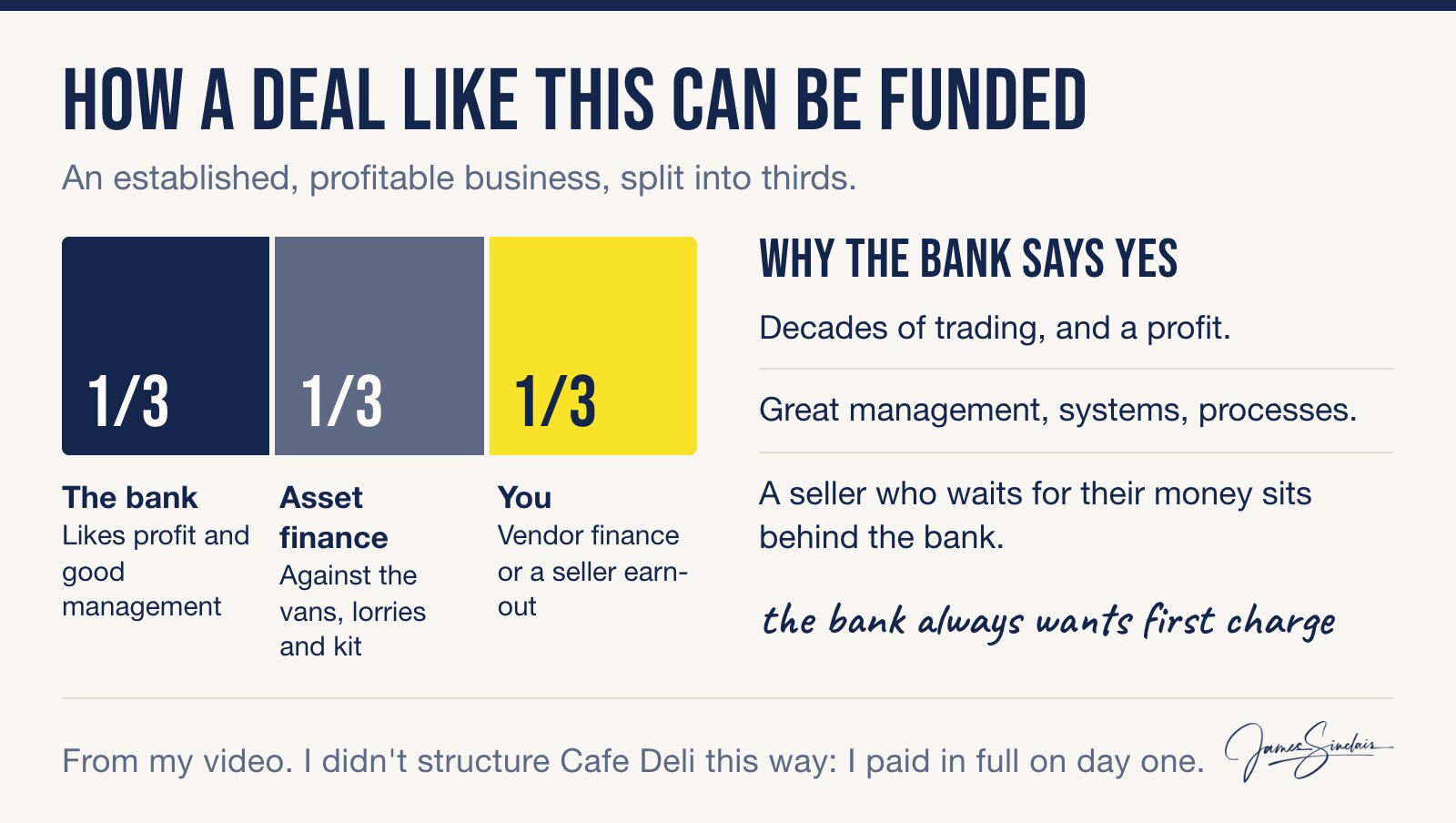
Haven't got that third? There are two ways the seller can help.
Vendor finance
The owner is paid their third as a loan over time, out of the business's profits. I've done 100% finance deals this way, and mixtures of both.
An earn-out
The sellers get a portion of the profits going forward, for five or 10 years, for example. It happens quite a lot.
Banks are quite supportive of both. The vendor sits behind the bank, which always wants first charge security. And the bank's comfortable that a seller prepared to wait for their money will stick around and help make the business a success.
Why I'd rather buy than build
I've done both. I started Twizzle Tops Day Nurseries from scratch, and we've now got 10 venues. I bought Rossi for £1.2 million and the Blue Boar Hotel for £2.2 million.
Cafe Deli is the biggest deal I've done in terms of revenue. I'd tried doing its job from the back of Rossi, and it put my business under pressure. Buying it gave me the vans, the team, the customers and three decades of know-how the day I signed.
Looking for your next business?
Buy, Don't Build is how I find businesses, negotiate, and pay sellers out of the business's own cash flow.
Take a look →Magically yours,
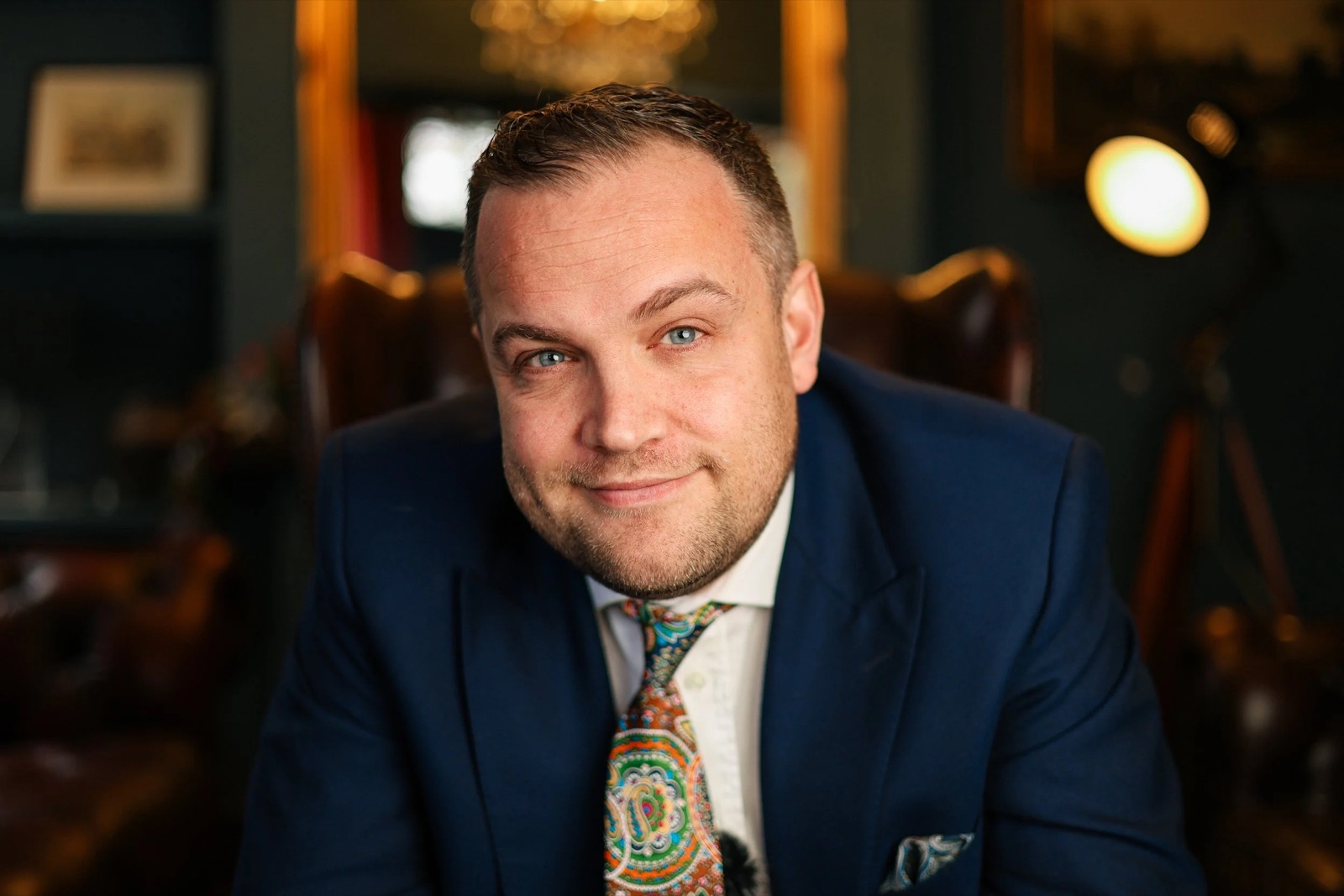
James Sinclair
Founder of a group of over 40 businesses
James started as a children's entertainer. Twenty years on, his group runs over 40 businesses with over 3,000 staff and one million customers a year, from farm parks and day nurseries to a hotel and a roller rink. Everything he writes comes from running them.