How much money does a hotel make? Here's my real P&L
I bought a hotel a couple of years ago for £2.25 million, and like everyone, I'd assumed hotels must be printing money. Lots of them are barely making a profit. So here are my real monthly numbers: what comes in, what goes out, and what it actually keeps.
Watch: how much money does my hotel make?
Why I bought a rough diamond
It needed polishing. When I bought it, only 16 rooms were open. Some weren't refurbished, some weren't even in use, and the restaurant was closed. The pub and bar were thriving, with regular customers, and there were odds and sods around the property nobody was using.
What I liked was the moat. Parts of the building are 500 years old, it's listed, and it sits right in the middle of the high street. Nobody can open a copy next door. It's an established business with a nice chunky freehold.
And it folds into what I already own. I can lean on my management team, my marketing team and the know-how we've built up over the years. A previous owner had let some rooms out as bedsits because that was easier. We know how to fill rooms.
What my hotel brings in, and what it keeps
I live by management accounts. These are from May to July.
Revenue was £74,000 in May, £77,000 in June and £86,000 in July. Rooms brought in about £35,000, then £38,000, then £48,000. July spiked because we had more rooms open.
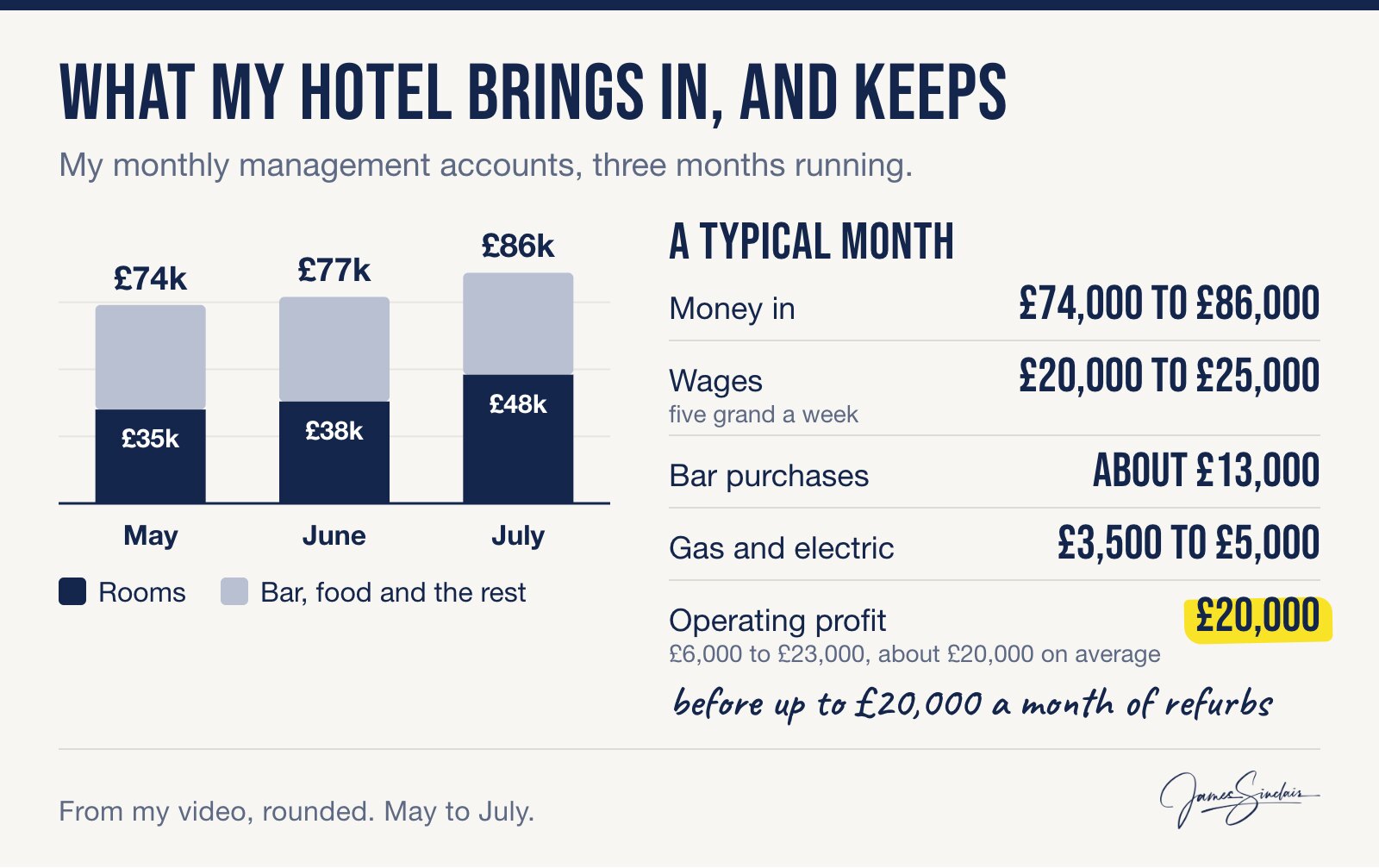
Wages run at a steady five grand a week: £25,000 in May, which was a five-week month, then £20,000 and £21,000. Gas and electric come to around £3,500 to £5,000 a month. We do the linen ourselves, in-house.
Operating profit has been anywhere between £6,000 and £23,000 a month, about £20,000 on average. I'm a happy man with that. But it isn't net profit.
If we're sinking £20,000 a month into refurbishing rooms, it takes a while for operating profit to turn into money you actually keep. We'll know at the year end.
How I read the lines
The line that blows my mind is drink sales. About £35,000 in May, and every month since has landed within a whisker of it. That's lovely, steady income.
Then I look at what we're buying for the bar: £13,000 in May, £13,000 in June, £12,500 in July. Steady purchases next to steady sales is exactly what you want to see.
If your gross profit fluctuates, someone might be stealing from you.
Ours is pretty consistent. That's why you take an opening and a closing stock take, so you can see it.
Car parking is small but consistent. And the commission line, what we pay Airbnb, booking.com and Expedia, is the one I'm watching shrink.
Own the customer
The biggest threat to most hotels is that they don't own their customers. Booking engines take anywhere between 15% and 30%, and that can be a big chunk of your profit.
When I got here, 70% of bookings came through booking.com. Now only a third come from all the platforms put together. Lots of people come direct.
Google ads
Pay-per-click on Google, driving people back to book with us.
Search engine optimisation
So people searching find us, and not just the booking engines.
Winning awards
Another reason for people to come straight to us.
Owning the data
Every direct booking is a customer we know, instead of one a booking engine knows.
Most hotel owners can't be bothered to do that. It's one of my biggest lessons from running a hotel.
Why 30 rooms is the number
A hotel never closes. It's 365 days a year, 24 hours a day, with guests checking in at midnight and wanting things at three in the morning. A 15-room hotel and a 50-room hotel both need a general manager and a cook for breakfast.
Once you get past 30 rooms, a night porter starts to stack up. Under that, you're probably on call yourself. That's why small hotels are so hard to make work.
The banks worked this out decades ago. HSBC, for example, will only lend on hotels with a minimum of 30 rooms. Their risk teams have done the working out, so I just swipe it and put it into my business.
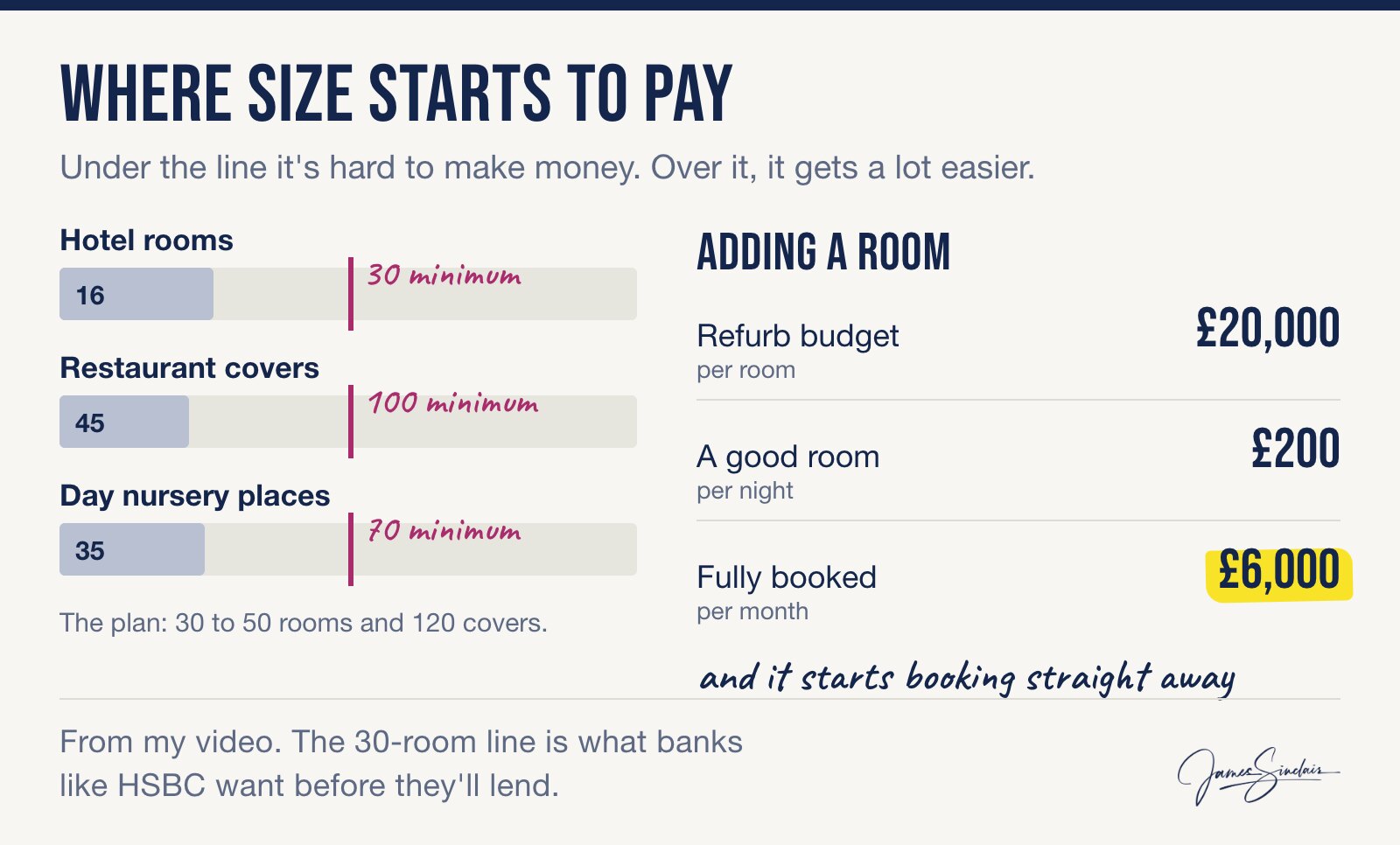
It's the same in my other businesses. A day nursery needs at least 70 places, and one with 35 is one nobody will want to buy. A restaurant needs at least 100 covers. One head chef can look after 200 seats as easily as 50.
Ask the banks what their lending criteria are for your sector. What makes them comfortable lending usually makes your business far more sellable too.
We're always building a business to sell, even if we have no intention of selling it.
So we're getting this place to at least 30 rooms. Every unused room is an opportunity. We budget around £20,000 to refurbish one, with the best mattresses, furniture, bathroom fittings and fire-rated everything. As soon as one opens, the bookings start.
One old bedsit could be a £200-a-night suite. Fully booked, that's £6,000 a month coming in.
Turning an okay model into a great one
A 15-room hotel is an okay business model. Thirty rooms plus is a much better one. Most businesses are okay models, so I look for the levers that make them great.
Secondary spend
People staying in a hotel spend more freely. A restaurant, a good bar and car parking all add to it.
A restaurant big enough to pay
We're using 45 seats for breakfast. Turn the kitchen into seating and we'll get 120 covers, run with a joint venture partner who'll be there till 1am doing the prep.
Economies of scale everywhere
The chambermaid manager who looks after the rooms might as well manage 30 as 10.
Pricing is the other lever I spend hours pondering, especially when times are tough. Being in lots of industries helps, because each business teaches the others.
Where it's heading
It's a good business. The problem is that it's 24/7, and it's hugely capital intensive. Guests don't treat a hotel like it's their home, things get hammered, and you keep pushing money into the rooms.
But I'm excited by the early signs.
Once it's really cooking, I think this will be a £3.5 million turnover business making £800,000 to £900,000 a year. It'll take five years, maybe seven, to get there.
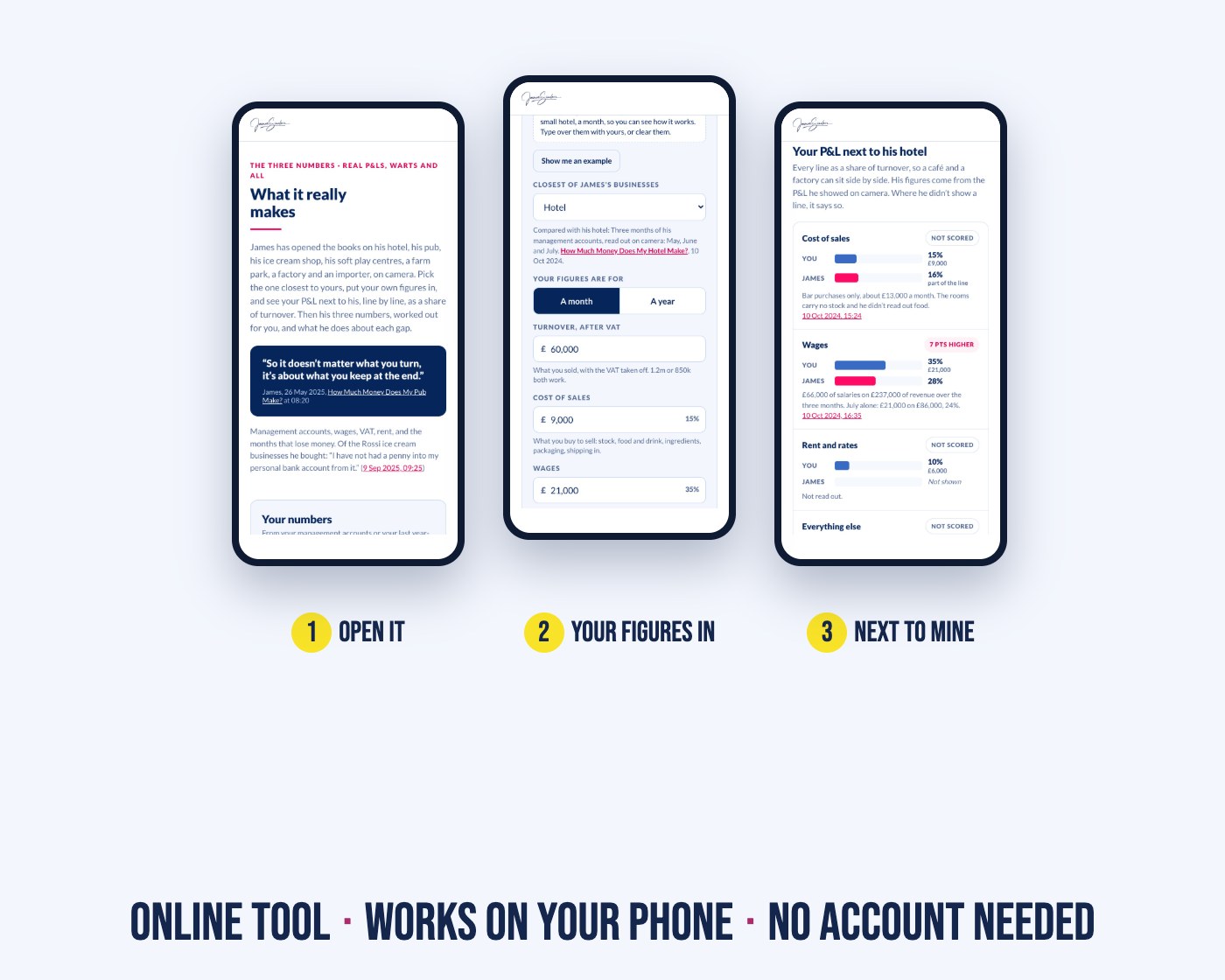
How does your P&L compare?
What It Really Makes puts your monthly numbers next to mine, line by line, and shows where you're different.
Take a look →Magically yours,
James Sinclair
Founder of a group of over 40 businesses
James started as a children's entertainer. Twenty years on, his group runs over 40 businesses with over 3,000 staff and one million customers a year, from farm parks and day nurseries to a hotel and a roller rink. Everything he writes comes from running them.